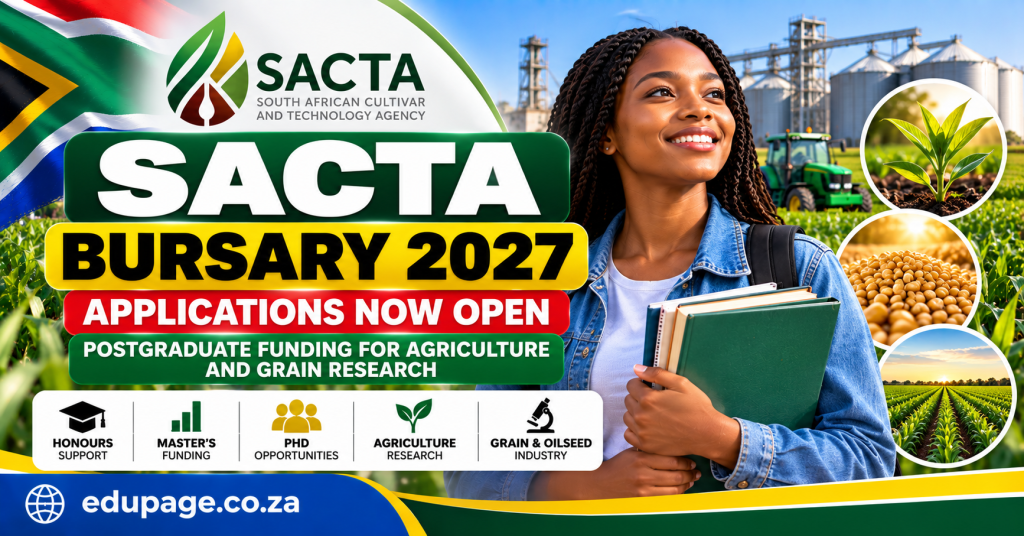
SACTA Bursary 2027 Applications: What Students Need to Know
South African postgraduate students interested in agriculture, crop science, food science and related research fields have an opportunity to apply for funding through the South African Cultivar and Technology Agency (SACTA).
Unlike many bursaries aimed at undergraduate students, the SACTA programme focuses on postgraduate research, particularly studies connected to South Africa’s grain and oilseed industries.
The current 2027 bursary information lists a 30 September 2026 closing date, meaning prospective applicants should prepare their supporting documents and research information well before the deadline.
SACTA’s published bursary criteria state that the programme supports Honours, Master’s and Doctoral studies, with research required to be relevant to the South African grain and oilseed industry.
What Is the SACTA Bursary?
SACTA is involved in supporting research and technology development in South Africa’s grain and oilseed industries.
Its bursary programme is designed to help develop postgraduate skills that can contribute to areas such as:
- Crop breeding
- Plant science
- Agricultural technology
- Soil science
- Crop protection
- Agricultural economics
- Food science
- Agricultural engineering
- Data and research
- Other relevant grain and oilseed disciplines
The programme therefore targets students whose studies can contribute to the development of South Africa’s agricultural sector.
SACTA Bursary 2027 Closing Date
Closing date: 30 September 2026
Current 2027 bursary listings identify 30 September 2026 as the closing date.
Applicants should not wait until the final day.
Useful Links:
Research-based bursary applications can require considerably more preparation than ordinary undergraduate applications because applicants may need to provide academic records, registration information and details of their proposed research.
Important: Applicants should verify the closing date and application instructions directly with SACTA or its appointed bursary administrator before submitting.
Who Can Apply for the SACTA Bursary?
The published SACTA criteria indicate that applicants generally need to satisfy several requirements.
Applicants should:
- Be South African citizens.
- Have completed matric.
- Be admitted to, or studying towards, an eligible full-time postgraduate qualification.
- Be pursuing Honours, Master’s or Doctoral studies.
- Study in a field relevant to the South African grain and oilseed industry.
- Conduct research that is relevant to SACTA’s objectives.
- Have an approved supervisor for the research programme.
- Meet the applicable SACTA bursary conditions.
- Be willing to work in the South African grain and oilseed industry for a period corresponding to the bursary funding period.
Applicants should read the current bursary documentation carefully because eligibility can depend on the specific programme and research proposal.
Which Qualifications Are Funded?
The SACTA bursary is primarily intended for postgraduate study.
The published criteria identify:
Honours
Students completing an Honours qualification may qualify if their programme and research are relevant to the grain and oilseed sector.
Master’s
SACTA supports Master’s-level research, particularly dissertation-based studies that address relevant agricultural and technology questions.
Doctoral
PhD candidates conducting relevant research can also be considered.
The programme is therefore particularly relevant to students who want to pursue careers in agricultural research, crop development, agricultural technology and related scientific fields.
Fields of Study
Current information about the SACTA bursary lists a broad range of relevant disciplines.
These can include:
- Agronomy
- Agricultural Economics
- Agricultural Engineering
- Agricultural Meteorology
- Biometry
- Conservation Agriculture
- Data Science
- Food Sciences
- Molecular Biology
- Pasture Science
- Plant Biochemistry
- Plant Breeding
- Plant Pathology
- Plant Physiology
- Soil Science
- Weed Science
The important consideration is not simply the name of the qualification.
The proposed research must be relevant to SACTA’s focus on the South African grain and oilseed industry.
How Much Does the SACTA Bursary Pay?
SACTA’s official published criteria state that annual bursary amounts are determined by SACTA each year.
Recent 2027 bursary listings report funding of up to approximately:
- R99,750 per year for Master’s by Dissertation
- R131,250 per year for PhD research
However, applicants should not treat these figures as guaranteed awards. Funding amounts and conditions can change from one academic year to another, and the final amount depends on SACTA’s current bursary policy.
This is an important distinction for students comparing bursaries: the advertised maximum is not necessarily the amount every successful applicant will receive.
What Documents Are Required?
SACTA’s published application criteria identify several documents that applicants may need to provide.
These include:
1. Completed application form
Applicants need to complete the relevant bursary application accurately.
2. South African ID or passport
A certified copy may be required.
3. Curriculum vitae
Your CV should provide a concise overview of your academic background, research experience and relevant achievements.
4. Academic transcript
Applicants should provide their latest academic record on official institutional documentation.
5. Proof of registration
Where applicable, applicants should provide proof of registration and a fee statement.
6. Research proposal information
Because this is a research-focused bursary, applicants should be prepared to provide information about their proposed dissertation or thesis.
The exact supporting-document requirements should be checked against the current application form before submission.
Your Research Proposal Matters
One of the biggest differences between the SACTA bursary and many general bursaries is the importance of the proposed research.
The published criteria state that the dissertation or thesis proposal must be approved by SACTA before studies commence. A university supervisor must also be designated and approved.
This means applicants should clearly explain:
- What problem they want to investigate
- Why the research matters
- How the research relates to grain or oilseed production
- What methodology they intend to use
- What results they expect
- How the research could benefit the agricultural sector
A well-developed research proposal can make it easier for reviewers to understand the relevance of the project.
SACTA Bursary Work-Back Requirement
Applicants should pay close attention to the programme’s work-back condition.
SACTA’s published criteria state that successful applicants are expected to work in the South African grain and oilseed industry for the same period for which the bursary was awarded.
This is an important condition.
Students should understand the obligation before accepting funding because it can affect their career plans after graduation.
How to Apply for the SACTA Bursary
The application process involves submitting the required information and supporting documents through the designated application process.
Step 1: Confirm your eligibility
Check that your qualification, research area and academic circumstances meet the current requirements.
Step 2: Prepare your documents
Gather your:
- ID
- CV
- Academic record
- Registration documents
- Fee statement, where applicable
- Research proposal
- Other requested supporting documents
Step 3: Discuss your research with your supervisor
Make sure your supervisor understands the research requirements and is available to support the application.
Step 4: Complete the application
Enter your personal, academic and research information carefully.
Step 5: Upload or submit supporting documents
Check that all documents are clear and complete.
Step 6: Submit before the deadline
For the current 2027 cycle, published information lists 30 September 2026 as the closing date.
Careers Supported by SACTA-Funded Research
A postgraduate qualification supported by SACTA can potentially lead to careers in areas such as:
- Agricultural research
- Plant breeding
- Crop science
- Soil science
- Agricultural technology
- Food science
- Agricultural economics
- Research institutions
- Universities
- Agricultural companies
- Grain and oilseed organisations
- Government agricultural programmes
The value of the programme therefore extends beyond the immediate financial assistance: it is connected to building specialist skills for an important part of the South African agricultural economy.
Why Agricultural Research Matters in South Africa
Agriculture requires specialised knowledge to address challenges involving productivity, climate conditions, soil health, crop diseases, food security and technological development.
Research in crop breeding and agricultural technology can contribute to improving the performance and resilience of crops.
SACTA’s focus on grain and oilseed research reflects the need for specialised expertise in these areas.
Its historical reporting also describes its bursary and internship programmes as part of efforts to develop human capital and skills within the agricultural sector.
SACTA Bursary Application Checklist
Before submitting your application, check:
☐ I am a South African citizen.
☐ I have completed matric.
☐ I am applying for an eligible postgraduate qualification.
☐ My studies are relevant to the grain and oilseed industry.
☐ My research proposal meets the programme’s requirements.
☐ I have an appropriate academic supervisor.
☐ My academic record is available.
☐ My CV is updated.
☐ My identification documents are ready.
☐ I understand the work-back requirement.
☐ I have checked the current application instructions.
☐ I will submit before 30 September 2026.
Frequently Asked Questions
Is the SACTA Bursary available for undergraduate students?
The published SACTA criteria state that the bursary is for Honours, Master’s and Doctoral studies, rather than ordinary undergraduate study.
What does SACTA stand for?
SACTA stands for the South African Cultivar and Technology Agency.
What fields does the bursary support?
Relevant fields include areas such as plant breeding, agronomy, agricultural economics, soil science, plant pathology, agricultural engineering, food science and other disciplines connected to the grain and oilseed sector.
What is the SACTA Bursary 2027 closing date?
Current 2027 listings state that applications close on 30 September 2026.
Does SACTA require a research proposal?
Yes. SACTA’s published criteria indicate that the dissertation or thesis proposal must be approved before the research commences.
Do successful students have to work in agriculture after graduation?
The published bursary conditions state that successful applicants are expected to work in the South African grain and oilseed industry for a period equivalent to the period funded.
Final Takeaway
The SACTA Bursary 2027 is aimed at South African postgraduate students whose research can contribute to the country’s grain and oilseed industries.
It is particularly relevant to students pursuing Honours, Master’s or Doctoral research in agricultural science, crop technology, plant science, food science, agricultural economics and related disciplines.
With the current application deadline listed as 30 September 2026, eligible students should begin preparing their academic records, CV, research information and supporting documents early.
Most importantly, applicants should read the latest SACTA bursary conditions before applying because funding amounts, requirements and application procedures can change.
Sources and References
- SACTA — South African Cultivar and Technology Agency: Official SACTA website.
- SACTA Bursary Criteria: Published SACTA bursary criteria covering postgraduate eligibility, documentation, research approval and work-back requirements.
- SACTA Bursary 2027 listing: Current 2027 application information and reported funding amounts.
- SACTA NPC Bursary information: Current eligibility and application-document information.
Publishing note: This article is intended for general educational and informational purposes. EduPage is not affiliated with SACTA. Because bursary amounts, eligibility criteria and deadlines can change, applicants should verify the latest requirements with SACTA or its authorised bursary administrator before submitting an application.