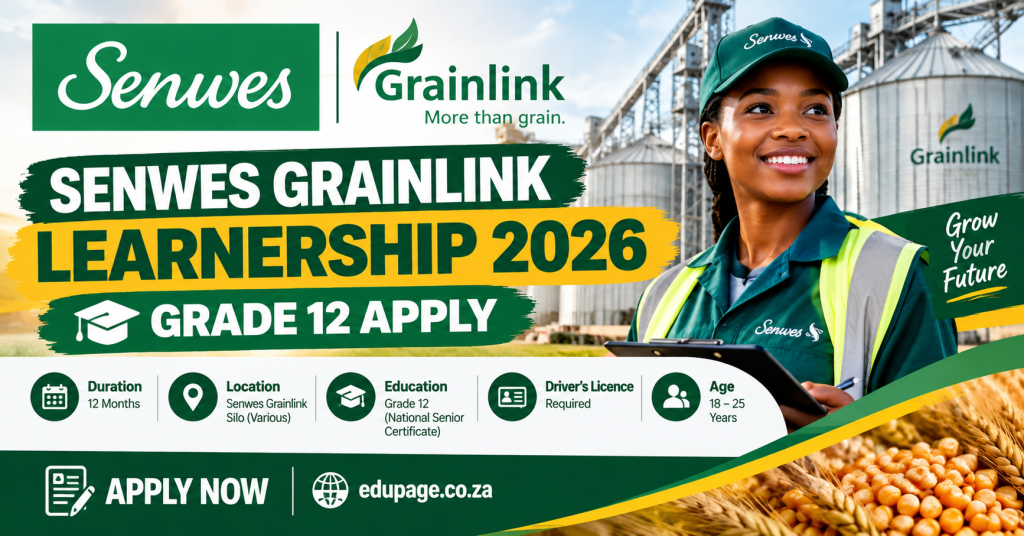
Senwes Grainlink Learnership 2026: Grade 12 Applicants Can Apply for 12-Month Agricultural Training
Young South Africans interested in agriculture, grain handling and technical operations can apply for the Senwes Grainlink Learnership 2026/2027, a 12-month workplace-based training opportunity designed to prepare learners for a career as a Junior Grain Grader.
The programme combines practical experience at a Senwes Grainlink silo with formal training in grain grading, grain handling and essential workplace skills. The current vacancy states that applicants must have a National Senior Certificate (Grade 12), a valid driver’s licence and be between 18 and 25 years old.
Applications are currently scheduled to close on 30 September 2026.
Senwes Grainlink Learnership 2026 at a Glance
| Detail | Information |
|---|---|
| Programme | Senwes Grainlink Learnership |
| Training area | Grain grading and silo operations |
| Career path | Junior Grain Grader |
| Duration | 12 months |
| Education | National Senior Certificate (Grade 12) |
| Driver’s licence | Valid driver’s licence required |
| Age | 18–25 years |
| Industry | Agriculture / Grain |
| Work environment | Senwes Grainlink silo |
| Closing date | 30 September 2026 |
| Application | Senwes career/recruitment portal |
Senwes describes its learnerships as vocational programmes that combine theoretical learning with practical workplace experience. The company’s early-careers information also states that learners receive a learner allowance during the duration of their learnership.
What Is the Senwes Grainlink Learnership?
Grainlink is the part of Senwes involved in grain handling, storage and market access. Senwes says its Grainlink infrastructure has a storage capacity of approximately 6.5 million tonnes and processes about 25% of South Africa’s summer and winter grain harvests.
This makes a Grainlink learnership different from a purely classroom-based programme.
Learners are placed in an operational agricultural environment where they can gain exposure to activities such as:
- Grain receiving and handling
- Silo operations
- Grain administration
- Grain quality processes
- Grain grading
- Workplace health and safety
- Computer literacy
- Communication
- Different grain commodities
- General operational procedures
The current vacancy describes the programme as a 12-month structured learnership involving on-the-job training at a Senwes silo. Learners can gain exposure to commodities including maize, sunflower and soya.
What Does a Junior Grain Grader Do?
Grain grading is an important part of the agricultural value chain.
Useful Links:
A grain grader works with agricultural products and assesses grain according to relevant quality and grading requirements. Accuracy is important because the quality of grain can influence how it is handled, stored and traded.
For a young person entering agriculture, learning about grain quality can therefore provide exposure to a specialised area of the agricultural industry rather than only general farm work.
The Senwes programme specifically aims to train learners toward the Junior Grain Grader role.
Senwes Grainlink Learnership Requirements
Candidates should carefully check the eligibility criteria before applying.
The current vacancy lists these key requirements:
1. Grade 12
Applicants must have a National Senior Certificate (Grade 12).
This means the opportunity is suitable for young people who have completed secondary school but may not yet have a tertiary qualification.
2. Valid Driver’s Licence
A valid driver’s licence is required.
Applicants should make sure their licence is valid and that the information supplied during the application matches their supporting documentation.
3. Age Requirement
Applicants must be between 18 and 25 years old.
Candidates outside the specified age range should not assume that they qualify unless Senwes provides different instructions in an updated vacancy notice.
4. Interest in Agriculture
The vacancy seeks young people who are interested in agriculture or technical fields.
An applicant does not necessarily need a university degree to begin developing a career in this area. The programme is structured around practical and formal learning.
5. Willingness to Work at a Silo
Successful candidates must be prepared to work in a silo environment and learn about grain operations.
This is important because the programme involves practical workplace exposure rather than being an entirely office-based opportunity.
What Skills Can Learners Gain?
The programme can help participants develop a combination of technical, operational and workplace skills.
These may include:
Grain-handling skills: Understanding how agricultural commodities move through a silo environment.
Grain-grading knowledge: Developing knowledge relevant to assessing grain quality.
Computer literacy: Building basic workplace technology skills.
Communication: Learning to communicate effectively with colleagues and other stakeholders.
Administration: Gaining exposure to operational record-keeping and procedures.
Workplace discipline: Developing reliability, time management and adherence to workplace procedures.
Health and safety: Learning why safety procedures are important in an industrial agricultural environment.
These skills can be valuable when building a longer-term career in agriculture, grain handling, logistics, operations or related areas.
Why Agricultural Learnerships Matter
Agriculture is a major part of South Africa’s economy and food system, but opportunities in the sector are not limited to farming.
The agricultural value chain also includes:
- Grain storage
- Grain grading
- Logistics
- Agricultural finance
- Procurement
- Commodity marketing
- Equipment and mechanisation
- Technical services
- Information technology
- Administration
- Supply-chain management
Senwes itself operates across areas including input supply, financial and technical services and market access. Its Grainlink business focuses specifically on grain storage, handling and market access.
For young people interested in agriculture, this means there are multiple possible career directions beyond traditional farming.
What Makes This Opportunity Different?
One notable feature of the Senwes Grainlink opportunity is that it combines workplace exposure with formal training.
Senwes explains that its learnership programmes combine classroom-based training, on-the-job training and assessments. The company’s early-careers programme also indicates that learnerships are registered with the relevant South African qualifications framework arrangements and that learners receive practical training and a learner allowance.
However, applicants should distinguish between a learner allowance and a permanent salary. A learnership is primarily a structured training opportunity and does not automatically guarantee permanent employment after completion.
How to Prepare Your Application
Competition for entry-level opportunities can be significant, so applicants should make sure their application is complete and accurate.
Before applying, prepare:
- Updated CV
- Grade 12 certificate
- Valid driver’s licence information
- Identity document, where requested
- Contact details
- Education information
- Any relevant agricultural or technical experience
- Any additional certificates that support your application
CV Tips for Applicants
Your CV should make your eligibility easy to identify.
For example, include your Grade 12 qualification clearly rather than hiding it among other information.
If you have experience working with machinery, agriculture, administration, computers, logistics or customer service, include it where relevant.
Do not add qualifications or experience that you do not have. Accurate applications are important because employers may verify information supplied during recruitment.
How to Apply for the Senwes Grainlink Learnership 2026
Applicants should apply through the Senwes recruitment/careers platform and follow the instructions provided in the current vacancy.
Senwes’ official early-careers page confirms that the company offers learnerships as part of its youth-development opportunities.
The current Grainlink vacancy instructs qualifying candidates to register and apply through the Senwes career page.
Application portal: Senwes Careers
Applicants should verify the vacancy title and requirements on the recruitment portal before submitting their application.
Closing Date: 30 September 2026
The current Senwes Grainlink Learnership vacancy lists 30 September 2026 as the closing date.
With the deadline approaching, eligible candidates should prepare their documents and submit their applications as early as possible.
Do not wait until the final day if you can apply earlier.
Frequently Asked Questions
Is the Senwes Grainlink Learnership open in 2026?
Yes. The current vacancy is for the 2026/2027 Senwes Grainlink Learnership, with applications closing on 30 September 2026.
How long is the Senwes Grainlink Learnership?
The programme is advertised as a 12-month structured learnership.
What qualification do I need?
You need a National Senior Certificate (Grade 12) according to the current vacancy.
Do I need a driver’s licence?
Yes. The current vacancy specifically lists a valid driver’s licence as a requirement.
What age must I be?
The current vacancy states that applicants must be 18 to 25 years old.
What career does the programme prepare learners for?
The programme provides training toward a Junior Grain Grader role and exposes learners to grain handling, silo operations and related workplace skills.
Does Senwes provide an allowance?
Senwes states on its early-careers page that learners receive a learner allowance for the duration of their learnership. The specific amount should be confirmed from the current vacancy or directly with Senwes rather than relying on figures published by third-party websites.
Can I apply without a university qualification?
Yes, the current Grainlink vacancy lists Grade 12 rather than a university degree as the educational requirement. Applicants must still meet the other requirements, including age and driver’s licence requirements.
Is this a permanent job?
No. It is advertised as a 12-month learnership, meaning it is a structured training opportunity rather than an automatic permanent appointment.
Beware of Learnership Scams
South African job seekers should be careful when applying for opportunities shared through Facebook, WhatsApp and other social-media platforms.
A legitimate employer should not require applicants to pay someone privately in exchange for a guaranteed job or learnership placement.
Before submitting sensitive information:
- Check the employer’s official website.
- Verify the vacancy on the employer’s recruitment platform.
- Check the closing date.
- Do not pay unofficial “application” or “placement” fees.
- Do not send banking passwords, PINs or one-time passwords.
- Be cautious of individuals promising guaranteed employment.
For this opportunity, applicants should use the Senwes recruitment channels rather than sending applications to unrelated individuals or social-media pages.
Final Takeaway
The Senwes Grainlink Learnership 2026/2027 offers qualifying young South Africans an opportunity to enter the agricultural industry through practical training in grain handling, silo operations and grain grading.
The programme is particularly relevant to applicants who have Grade 12, a valid driver’s licence, are aged 18–25 and have an interest in agriculture or technical work. The programme lasts 12 months, and Senwes says its learnerships provide practical training and a learner allowance.
The current closing date is 30 September 2026, so eligible applicants should check the official recruitment platform and submit complete applications before the deadline.
Sources and References
- Senwes Early Careers — information about Senwes learnerships, practical training, qualifications and learner allowances.
- Senwes Grainlink — official information about grain storage, handling, market access and silo operations.
- Senwes Grainlink Learnership vacancy — requirements, programme duration and closing date.
- Nasi Ispani — current publication covering the 2026/2027 Grainlink Learnership and 30 September 2026 closing date.
Publishing note: This article was prepared using information available on 22 September 2026. Vacancy details can change, including closing dates, eligibility requirements and application instructions. Edupage should verify the official Senwes vacancy before publication and update this article if Senwes changes the opportunity. Third-party websites are used for cross-checking, while applicants should rely on Senwes’ official recruitment channels when applying.