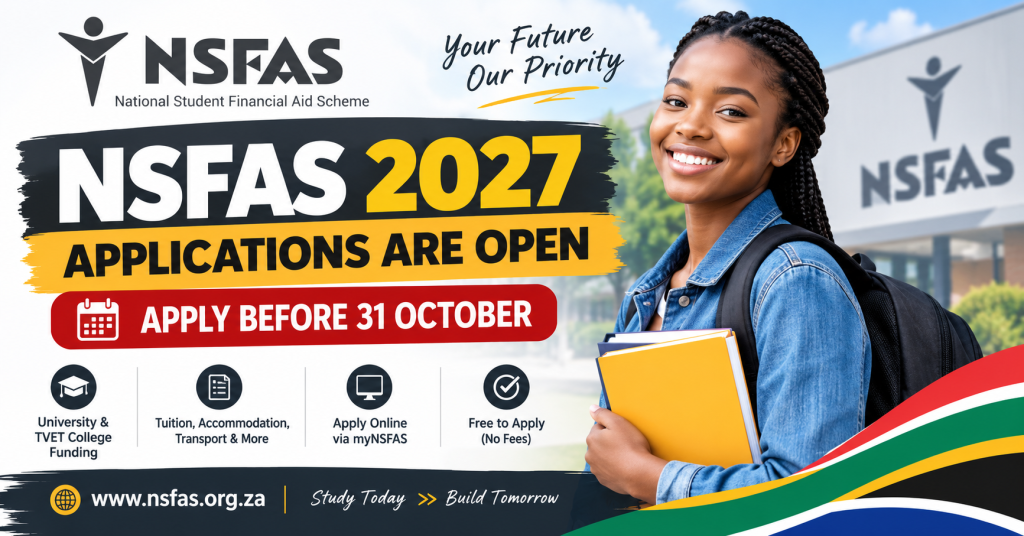
NSFAS 2027 Applications Are Open: South African Students Have Until 31 October to Apply
NSFAS 2027 applications are officially open, giving eligible South African students an opportunity to apply for financial assistance for the 2027 academic year.
The National Student Financial Aid Scheme opened the 2027 application window on 18 September 2026. According to the official NSFAS application website, applications will close on 31 October 2026. Students are encouraged to apply early rather than waiting until the final days of the application period.
The opening of the 2027 cycle is important for prospective university and TVET college students who may need financial assistance to cover the costs associated with their studies.
NSFAS has also introduced changes to its application and verification processes for the 2027 cycle, including automated document verification, electronic document signing and stronger verification of student information.
NSFAS 2027 Applications: Key Dates
| Important detail | 2027 information |
|---|---|
| Applications opened | 18 September 2026 |
| Application deadline | 31 October 2026 |
| Academic year | 2027 |
| Application fee | None |
| Application platform | Official NSFAS/myNSFAS channels |
| Funding areas | Public universities and TVET colleges, subject to NSFAS rules |
| Status tracking | myNSFAS |
The deadline above comes directly from the current official NSFAS application page. Applicants should rely on nsfas.org.za for updates because application dates and requirements can change.
Who Should Consider Applying for NSFAS in 2027?
NSFAS is designed to provide financial assistance to qualifying students who want to study at approved public universities and TVET colleges.
Prospective students planning to study in 2027 should investigate NSFAS funding if they expect that household finances could make tertiary education difficult to afford.
The application process requires applicants to provide personal and household information and give NSFAS permission to verify information through relevant third-party sources.
Importantly, submitting an application does not automatically guarantee funding. Applicants must meet the applicable funding requirements, and funding is subject to NSFAS’s rules and verification processes.
Useful Links:
What Can NSFAS Funding Cover?
The official NSFAS application information explains that approved funding can include different forms of student support, depending on the student’s institution, qualification and circumstances.
Potential areas include:
- Tuition and registration costs
- Accommodation for qualifying students
- Transport allowances in applicable circumstances
- Learning materials
- Personal-care allowances for qualifying students
Tuition and registration payments are made directly to the relevant university or TVET college, while other allowances depend on the applicable NSFAS funding policy.
Students should therefore avoid assuming that every NSFAS-funded student receives exactly the same allowances.
How to Apply for NSFAS 2027
The 2027 application process is completed online.
Step 1: Create or access your myNSFAS account
Applicants who do not already have an account need to register using their South African ID number, cellphone number and email address.
Existing users can sign in to their account and proceed with the application.
Step 2: Complete your personal information
Applicants must provide the requested personal and household information.
Accuracy is important because NSFAS verifies information against third-party sources.
Step 3: Complete the required consent process
The official NSFAS documentation includes a consent form that allows the scheme to verify information provided by the applicant and relevant family members.
Step 4: Upload supporting documents
Applicants should prepare clear copies or photographs of required documents.
NSFAS specifically warns that documents can be rejected when, for example:
- Pages are cut off.
- Images are blurry.
- Text cannot be read.
- Required signatures are missing.
- The wrong version of a form is used.
- Names or ID numbers do not match.
- Only part of a multi-page document is submitted.
Step 5: Review and submit
Before submitting, carefully check your information.
Once the application has been submitted, save the application reference number so that you can track your progress.
Documents You May Need for NSFAS 2027
The precise documents required can depend on the applicant’s circumstances.
The current official NSFAS application page identifies documents and forms for different categories of applicants, including:
- NSFAS consent documentation
- Declaration documentation for applicants aged 34 and younger
- Disability annexure and medical report where applicable
- Orphan and vulnerable-child declaration where applicable
Applicants should use the current NSFAS document checklist rather than relying on an old checklist shared on Facebook, WhatsApp or other social platforms.
What Happens After You Apply?
Submitting the application is only the beginning of the process.
NSFAS uses a series of stages to process applications. These can include verification of information, requesting additional documents where necessary and determining whether the applicant meets the funding requirements.
The official application system allows students to track their application through myNSFAS.
Applicants should regularly check their account rather than relying exclusively on messages from third parties.
Why Students Should Apply Early
Waiting until the last day creates unnecessary pressure.
An early application gives students more time to:
- Complete their information.
- Obtain missing documents.
- Correct errors.
- Respond to requests for additional information.
- Resolve account problems.
- Check their application status.
NSFAS itself is encouraging prospective students to apply early during the 2027 cycle.
With the official closing date currently listed as 31 October 2026, applicants should not assume that they will receive extra time after the deadline.
NSFAS 2027 and the Cost of Studying
For many South African households, deciding whether to study involves more than calculating tuition fees.
Students and families may also need to consider:
- Accommodation
- Transport
- Food
- Textbooks and study materials
- Registration costs
- Internet and connectivity
- Personal expenses
- Relocation costs for students studying away from home
This is why students should understand the difference between financial aid eligibility and the actual cost of attending an institution.
A student may qualify for funding while still needing to plan carefully for expenses that are not fully covered or that depend on the applicable funding policy.
A useful approach is to create a simple study budget before registration. List expected education costs, household contributions and other available sources of legitimate financial assistance. This can help students avoid taking unnecessary high-cost debt to cover expenses that could have been planned for in advance.
NSFAS 2027 and the “Missing Middle”
Another issue highlighted during the 2027 application launch is support for students who fall outside the traditional NSFAS bursary threshold but still struggle to afford higher education.
Higher Education and Training Minister Buti Manamela said work had started on a Loan Management System intended to support student loans for the so-called “missing middle”.
This should not be confused with automatic NSFAS bursary eligibility.
Students should check the specific financial-aid product and eligibility requirements applicable to their circumstances before making financial decisions.
New NSFAS System Improvements for 2027
NSFAS has announced several changes intended to improve the application and student-support process.
According to the Department of Higher Education and Training’s announcement reported by SAnews, these include:
Automated document verification
The system is being strengthened to improve how supporting documents are checked.
Electronic document signing
The 2027 process includes electronic document-signing functionality designed to simplify parts of the application process.
Improved information verification
NSFAS is strengthening verification of student registration and banking information through collaboration with the Department of Home Affairs.
Appeals administration
NSFAS has also indicated that attention has been given to improving the administration and communication surrounding appeals.
These changes are intended to make the process more efficient, although students should still carefully monitor their applications and respond to requests shown on their official accounts.
Important NSFAS Scam Warning
Students should be extremely careful when receiving NSFAS information through social media.
NSFAS has previously warned about false application dates and misleading funding claims circulating online.
There is an especially simple rule to remember:
You do not need to pay someone to submit an NSFAS application for you.
The official NSFAS website states that applications are free. It also warns applicants never to share their password or one-time PIN with another person.
Avoid anyone who claims they can:
- Guarantee NSFAS funding.
- Change an unsuccessful application for payment.
- Speed up funding for a fee.
- Sell an NSFAS application slot.
- Request your NSFAS password.
- Ask for your OTP.
- Require payment to submit your application.
For security, type the official NSFAS website address into your browser instead of clicking suspicious links received through WhatsApp or social media.
NSFAS 2027 Application Deadline
The current official NSFAS website lists:
Applications opened: 18 September 2026
Applications close: 31 October 2026
This is an important correction because some third-party reports circulating online have published different dates. The official NSFAS application page should take priority when dates conflict.
Students should therefore work with 31 October 2026 as the current deadline unless NSFAS officially announces a change.
Frequently Asked Questions
Are NSFAS 2027 applications open?
Yes. NSFAS opened applications for the 2027 academic year on 18 September 2026.
When do NSFAS 2027 applications close?
The official NSFAS website currently lists 31 October 2026 as the closing date.
Is it free to apply for NSFAS?
Yes. NSFAS states that applying for funding is free. Applicants should not pay anyone to submit or accelerate an application.
Can I apply using my phone?
Yes. The official NSFAS application system is designed to work online and applicants can upload photographs of documents from a phone, provided the documents are clear and complete.
What if my document is rejected?
Sign into your myNSFAS account and check what information or document NSFAS requires. Correct the problem and upload the requested documentation according to the instructions.
Does applying guarantee NSFAS funding?
No. An application must go through the applicable eligibility and verification processes before funding is confirmed.
Can I track my NSFAS application?
Yes. Applicants can use their myNSFAS account to follow the progress of their application.
Final Takeaway
The NSFAS 2027 application season is now open, providing prospective South African university and TVET college students with an opportunity to apply for financial assistance for the 2027 academic year.
The most important dates currently confirmed by NSFAS are 18 September 2026, when applications opened, and 31 October 2026, when applications are scheduled to close.
Students should apply as early as possible, prepare their documents carefully and monitor their myNSFAS account throughout the application process.
Most importantly, use official NSFAS channels and remember that NSFAS applications are free. Do not give your password, OTP or money to anyone claiming they can guarantee or accelerate your funding.
Sources and References
- NSFAS — Official 2027 Application and How-to-Apply Information: The primary source for the 2027 application dates, application process, supporting documents, tracking and security guidance.
- SAnews — NSFAS 2027 Application Cycle Opens: Government news coverage of the launch and system changes announced for the 2027 cycle.
- The Citizen — NSFAS 2027 Applications: Independent reporting on the 2027 application launch and system changes.
- IOL/The Post — NSFAS Scam Warning: Reporting on warnings concerning false application dates and funding claims.
Editorial and Publishing Note
This article was prepared using current official NSFAS information and recent reporting available as of 21 September 2026. Where information from news reports differs from the official NSFAS application portal, the official NSFAS source is treated as the primary reference. Readers should check the official NSFAS website before acting on application dates, eligibility requirements or funding announcements because these details can change.